Corgi Raises $108M to Rebuild Startup Insurance From First Principles
Your Series A closing is being held up by an insurance policy your broker can't produce in time. Your enterprise contract is stalled because procurement wants a certificate nobody can generate this week. Your board candidate is interviewing elsewhere while you're still shopping carriers.
Every player in the chain—broker, MGA, carrier—was built for Fortune 500 companies on annual renewal cycles. Not for companies that move at the speed of term sheets and deployment pipelines.
Corgi took the path no insurtech would: two years and tens of millions of dollars to become the carrier itself, rebuilding the product from the ground up.
The result: $0 to $40 million in ARR in six months. In B2B insurance.
We call it the Full-Stack Imperative: the only way to build insurance that keeps pace with startups is to own the entire stack—underwriting, pricing, policy language, claims, everything.
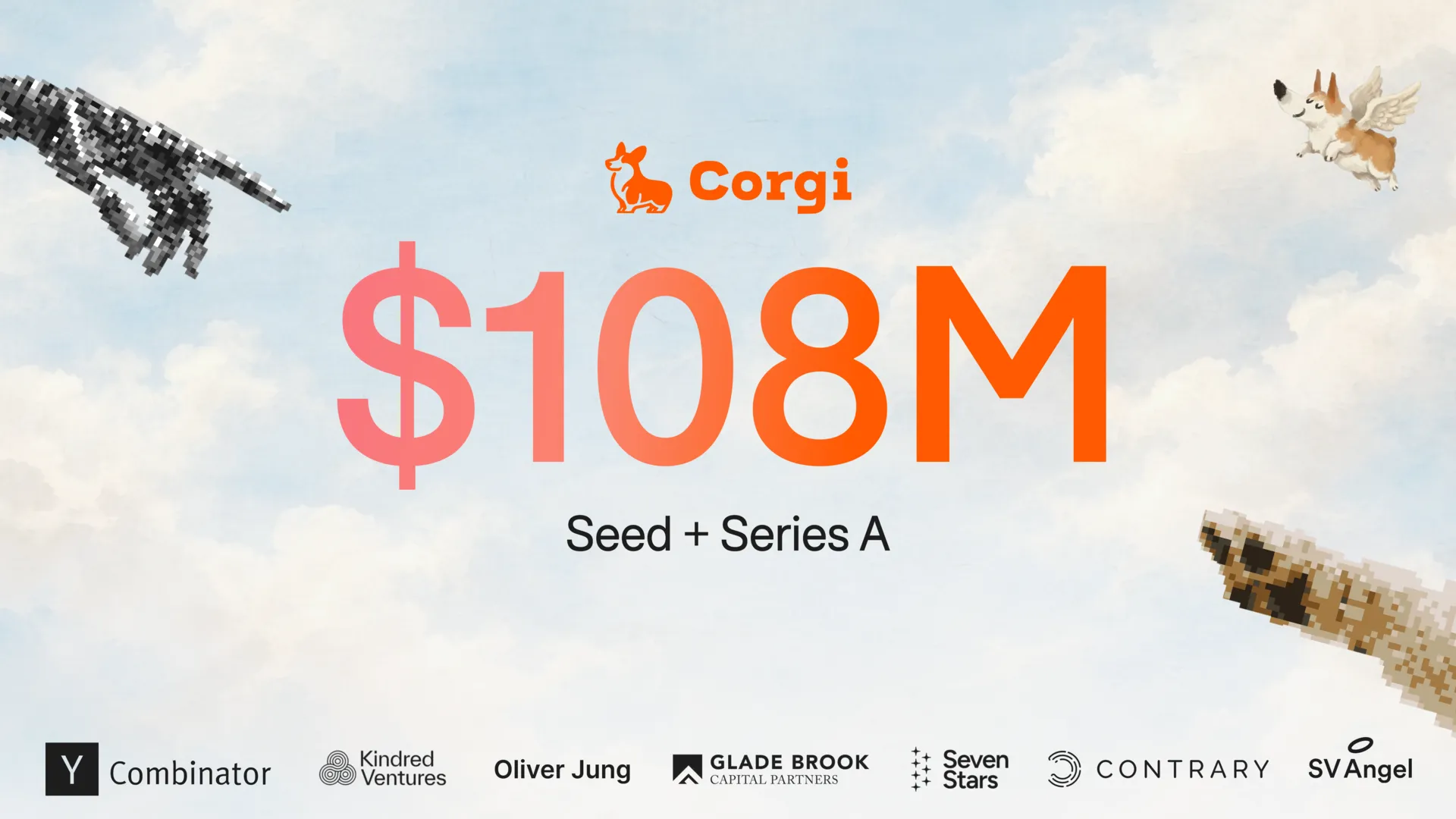
Today, Corgi announced $108 million in total funding (encompassing a recent Series A and prior seed) from Y Combinator, Kindred Ventures, Contrary, Oliver Jung, SV Angel, Phosphor Capital, and others. The company is the first vertically integrated insurance carrier built specifically for startups—controlling underwriting, pricing, policy language, claims, and the entire customer experience end-to-end.
$108M raised · $630M valuation · $0 → $40M ARR in 6 months · 1,000+ quotes in first 24 hours
The Problem Nobody Solved
Delayed closings, stalled contracts, lost candidates—these failures play out at every venture-backed company that buys insurance. But the delays are only the visible symptom.
The deeper failure shows up after you buy. You file a claim and discover policy exclusions your broker never explained. You're paying legal defense out of pocket despite having "coverage." The policy was written for a different kind of company entirely—one that renews once a year and never expected a claim from an AI model.
And when you try to fix it? You can't. Your broker can't change the underwriting. The carrier won't customize the policy. Nobody in the chain has the incentive or the authority to build what startups actually need. They just keep reselling the same product with a better interface.
Every insurtech of the past decade tried to solve this from the wrong layer.
Why Owning the Stack Changes Everything
The structural problem is straightforward. Traditional startup insurance involves at least four layers:
Startup → Broker (10%+ commission) → MGA (margin) → Carrier (sets terms) → Reinsurer
The broker—the only party the founder ever talks to—controls nothing. Not underwriting speed, not policy language, not pricing, not claims. They're reselling products built by entities that have never heard of a SAFE note.
Even the better digital brokers hit this wall. Embroker built better UX and developed some proprietary products, but still doesn't control full underwriting across its lines. Vouch started as an MGA and has moved closer to vertical integration—the closest competitor to Corgi's approach—but didn't build its carrier from scratch with AI-native underwriting, and its product scope remains narrower. Coalition built a real cyber carrier but stays focused on cyber, not broad startup coverage.
Corgi collapsed the entire stack:
Startup → Corgi (carrier, underwriter, claims handler)
One entity. Full control. Corgi's proprietary AI underwriting engine prices risk based on how startups actually operate, not industry codes written before SaaS existed. Instant underwriting without relay delays. Coverage tailored to startup business models. Claims handled by the same team that wrote the policy. And better unit economics—Corgi captures the margin that used to be split across four intermediaries while charging founders less.
Full-stack control also means Corgi can create entirely new coverage lines that legacy carriers struggle with—like AI Liability, covering risks few legacy carriers underwrite well. Try getting that underwritten by a carrier that still requires fax machines to bind policies.
This isn't an incremental improvement. It's a structurally different product.
The Full-Stack Imperative: Before & After
| Traditional (Broker → Carrier) | Corgi (Full-Stack) | |
|---|---|---|
| Quote speed | 5–7 business days | Minutes (AI underwriting) |
| Intermediaries | 4+ layers | 1 |
| Broker commission | 10%+ markup | $0 |
| AI Liability coverage | Limited / rare | Purpose-built |
| Claims accountability | "Call your broker" | Direct to the team that wrote the policy |
| Policy customization | Generic industry codes | Startup-specific risk models |
The Impossible Bet

Nico Laqua
Co-founder & CEO

Emily Yuan
Co-founder
When Nico Laqua and Emily Yuan joined Y Combinator's Summer 2024 batch, they started with a more practical plan: build a digital broker that would make buying insurance easier. They got their broker's license, started selling, and quickly generated tens of thousands in premium during the batch.
Then they hit the wall that every insurtech eventually hits. The insurance products themselves—underwritten by legacy carriers like Chubb—were fundamentally broken for startups. Generic policies full of gaps. Slow underwriting. And the final indignity: needing a fax machine to bind policies.
So mid-batch, they made a decision that most of their team thought was insane. Shut down their working broker business. Become the insurance carrier.
This meant acquiring an insurance company—roughly $30 million in license acquisitions and regulatory capital. During YC. While carrying approximately $30 million in debt. With ARR reset to zero. The team fractured. Over half left. One advisor Nico deeply respected told him: "This is a crazy idea, and not in a good way—it won't work."
One person believed: Jared Friedman.
"What Corgi has done is incredible and will be an inspiration to future generations of founders. How do you buy a $30M insurance carrier with just $500K from YC? It seems impossible. And yet, Nico and Emily pulled it off. How they did it is a tale for the ages, and a testament to the power of raw ambition and relentless execution." — Jared Friedman, Y Combinator
What followed was a two-year regulatory approval process spanning roughly 20 steps—state insurance department reviews, actuarial examinations, compliance frameworks—many running in parallel but each on its own timeline. Corgi began commercial operations after receiving approvals in July 2025 and completed the final step of its regulatory journey on December 24, 2025.
That regulatory gauntlet is now the moat.
What Founders Actually Get
Here's what changes when the carrier is built for startup speed—not enterprise bureaucracy.
A Series B founder gets a term sheet on Friday requiring D&O before closing Monday. With a traditional broker, that's a week of phone calls, form-filling, and waiting for a carrier they've never met to underwrite a business model they don't understand. With Corgi, the AI underwriting engine prices the risk before the call ends—models built on how startups actually operate, not actuarial tables that predate the internet.
When an enterprise customer's procurement team demands proof of E&O and Cyber with specific limits, Corgi's contract risk analysis reads the agreement, identifies exactly what insurance requirements must be met, and generates the coverage. No broker relay. No three-day turnaround.
The economics are better because there's no 10% broker markup to absorb. Coverage scales with company stage—from pre-seed CGL and D&O to growth-stage fiduciary liability and M&A representations & warranties. And when something goes wrong, founders work directly with the team that set the terms and pays the claims. That's real accountability.
Coverage spans nine lines: D&O, E&O, Cyber, CGL, EPLI, Fiduciary Liability, HNOA, Media Liability, and Representations & Warranties. For AI companies—a growing share of every YC batch—Corgi offers purpose-built AI Liability coverage: algorithmic bias, hallucination risk, IP infringement from model outputs, and model failure. No legacy carrier underwrites this well because they don't understand the risk. Corgi does, because its underwriting models were built for exactly this.
That breadth compounds. Each coverage line generates proprietary risk data that makes the next line more accurate to price—a compounding advantage legacy carriers can't replicate because they never owned the full stack to begin with.
"True innovation in insurance requires a special combination of actuarial science, AI-driven systems, and a fundamental rethinking of policy management. Corgi brings rare tenacity and technical focus to one of the hardest challenges in financial services by launching a new carrier to transform insurance, starting with technology companies." — Kanyi Maqubela, General Partner at Kindred Ventures
The Market Responds
When Corgi came out of stealth, 1,000+ founders requested quotes in the first 24 hours. Not page views—actual quote requests from companies ready to switch carriers.
Since beginning commercial operations in July 2025, Corgi has scaled from $0 to $40 million in ARR in approximately six months. In B2B insurance—where policies last a year, buying cycles are long, and switching costs are real—that velocity signals something specific: founders have been waiting for this product. The demand was always there. The infrastructure to serve it wasn't.
What's Next
The $108 million funds three priorities: product expansion into additional coverage lines and deeper AI liability products; geographic scaling through licensing and distribution expansion nationwide; and continued investment in its underwriting models—the actuarial science and risk engines that let Corgi price more accurately than carriers using decades-old assumptions.
The distribution strategy goes beyond direct sales. This means Corgi will show up where you already work—inside your cap table platform, your accelerator's dashboard, your law firm's closing checklist—so you don't have to go find insurance separately. Corgi's API-first architecture lets these platforms embed insurance directly into their workflows. A founder signing a SAFE on a cap table platform gets prompted with Corgi coverage at the moment they need it. This isn't just a distribution channel—it turns Corgi into infrastructure that other platforms build on, compounding distribution without proportional sales spend.
The vision extends beyond startups. Corgi is positioning to serve any business that moves faster than legacy carriers can accommodate—a wedge into the roughly $300 billion U.S. commercial insurance market that hasn't been meaningfully rebuilt in decades.
What We're Watching
We're not naive about the challenges. Here's what we're tracking:
- State-by-state licensing. Corgi can't flip a switch to go nationwide. Each state requires separate regulatory approval, and the timeline isn't fully in their control.
- Loss-ratio volatility. Limited actuarial history on a new portfolio means early loss ratios could swing. One bad quarter doesn't mean the model is wrong, but capital reserves need to absorb the learning curve.
- Reinsurance dependency. Like all carriers, Corgi needs reinsurance partners. Those relationships are working today, but reinsurance markets have their own cycles and pricing pressures.
- Funding market correlation. A startup-only customer base is cyclical with funding markets. If venture funding contracts, new policy originations slow.
These constraints are real. They're also what makes the opportunity defensible—the same barriers that shape Corgi's growth trajectory are the ones that prevent commoditization.
If you're evaluating Corgi today: the company is live, writing policies, and paying claims. These are growth constraints, not product risks.
Why We Invested
Despite those headwinds, the structural advantage is clear.
Nico and Emily understood the insight that eluded every predecessor: the only way to deliver insurance that moves as fast as the companies it covers is to own the entire stack. Underwriting. Pricing. Policy language. Claims. Everything. That meant doing what almost nobody is willing to do—navigate years of regulatory complexity and deploy tens of millions in capital before writing a single policy.
This is a classic vertical integration play with compounding advantages. The unit economics are fundamentally better: vertical integration eliminates the broker's 10%+ take while giving Corgi direct control over loss ratios and pricing accuracy. The regulatory licenses create a durable moat—every state approval, every actuarial filing, every compliance framework adds to a barrier that no amount of engineering talent can shortcut. The AI underwriting engine gets more accurate with every policy written, creating a data flywheel that widens the gap against incumbents still running models built on decades-old actuarial tables. And the API-first distribution strategy means Corgi doesn't just sell direct—it becomes the insurance layer that accelerators, law firms, and fintech platforms build into their own products. That's a compounding distribution advantage that looks more like infrastructure than a sales motion.
The traction validated the thesis faster than we expected. A thousand quotes in 24 hours. Forty million in ARR in six months. Founders voting with their wallets because the product solves real pain at critical business moments—closing rounds, signing enterprise contracts, onboarding board members.
The $300 billion U.S. commercial insurance market hasn't been structurally rebuilt for the modern era. The companies that transform it will follow the Full-Stack Imperative—own the infrastructure, not the interface.
Two years in regulatory purgatory. Thirty million in debt during YC. Half the team walked. One respected advisor said it would never work.
Forty million in ARR in six months was the answer.
Interested in learning more about our investment approach? Explore our funds or meet our team.